

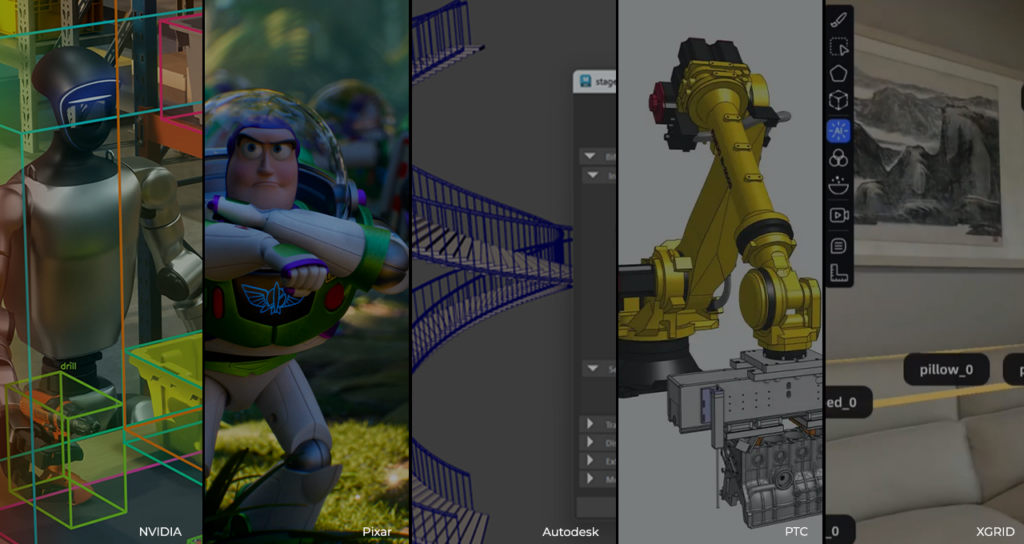
A Quarter of Momentum
Summer moved fast for the AOUSD community. Between new software releases, a packed SIGGRAPH program, and several new members, Q3 2026 highlighted the momentum of the OpenUSD ecosystem as it continues expanding into new areas and use cases. Here’s what AOUSD members have been building, releasing, and presenting over the past three months.
Growing the Alliance
AOUSD welcomed new General Members in July: ByteDance, Huawei, Physicl and Unity. Physicl joined as a contributor to the Physics Working Group, where it plans to help develop a normative physics schema so simulation data can move reliably between tools. ByteDance’s arrival coincided with its participation in SIGGRAPH 2026, where it presented a workshop on efficient 3D content creation for immersive experiences. Unity’s membership, meanwhile, brings another major real-time and game-development platform into the Alliance.
AOUSD takeaway: New members from physics simulation, game development, and immersive media point to OpenUSD’s reach well beyond its animation and VFX roots.
Autodesk
Autodesk continues to expand its support for OpenUSD across its content-creation tools, including Maya and 3ds Max. Maya’s new Dynamic Payloads bring more procedural flexibility to USD workflows. Artists can convert a Bifrost asset to USD while preserving its procedural capabilities. The result is an asset that stays lightweight, fully procedural, and easy to share. Watch the walkthrough and Bifrost release notes for more details.
Maya and 3ds Max also picked up a new Path Editor that brings every path on a stage into one view for easier management, covered in the docs for Maya and 3ds Max. And in July, Khronos Group announced Autodesk’s sponsorship of an open source glTF importer/exporter for 3ds Max, broadening interoperability between OpenUSD and other open 3D formats.
AOUSD takeaway: Autodesk is deepening USD support directly inside its core content-creation tools while also investing in interoperability with adjacent open standards.
Pixar
In July, Pixar helped deliver OpenUSD v26.08, bringing new features and improvements to the ecosystem. It later opened its newest RenderMan art challenge, Diorama Drama – running July 22 through October 19 and the first built around XPU. The challenge invites artists to build a character-centered story inside an isometric environment using USD models contributed by BigMediumSmall, KitBash3D, and Netflix/Tonko House, with shading, lighting, rendering, and compositing all in play and prizes including a Dell mobile workstation powered by AMD and NVIDIA. Then in July, Pixar and Autodesk jointly led an OpenUSD session at SIGGRAPH 2026 covering composition, rendering, physics, and other OpenUSD technologies.
AOUSD takeaway: Between a new USD release and a challenge built on USD assets contributed by multiple studios, Pixar keeps investing in both the format itself and the creative community that uses it.
NVIDIA
NVIDIA centered on connecting OpenUSD with agentic AI. In July, NVIDIA expanded its Agent Toolkit with new Omniverse libraries built on OpenUSD, giving AI agents the ability to inspect 3D scenes, generate sensor outputs, test physics, and convert CAD data into OpenUSD-based simulation-ready assets. NVIDIA also provided developer guidance on how AI agents can help teams prepare 3D scenes for simulation and develop lightweight USD runtimes.
AOUSD takeaway: NVIDIA’s work is a strong signal of where the ecosystem is headed, connecting OpenUSD with agentic AI so both developers and AI agents can build and validate 3D pipelines faster.
PTC
PTC was highlighted this quarter for a multi-agent workflow that automatically prepares CAD models in OpenUSD for robotics simulation – an example of USD acting as the connective layer between design and physical AI.
AOUSD takeaway: Industrial CAD-to-simulation pipelines are another sign that OpenUSD’s role is expanding from content creation into engineering and robotics workflows.
XGRIDS
This quarter’s Meet the Visionary profile featured XGRIDS‘ Mindy Li on how the company connects LiDAR, imagery, point clouds, and 3D Gaussian Splatting data with visualization, simulation, digital twin, and physical AI workflows using OpenUSD – XGRIDS is also contributing to community work on representing large-scale 3DGS datasets and level of detail in OpenUSD.
AOUSD takeaway: Reality capture and geospatial data are a real growth area for OpenUSD, extending the standard from synthetic 3D content into representations of the physical world.
A Widening Ecosystem
These developments show just how much the OpenUSD ecosystem is broadening. Members are applying the standard across AI, developer tooling, reality capture, geospatial data, robotics, industrial workflows, and entertainment – bringing new use cases and perspectives into the community. At the same time, continued growth is bringing more organizations to the table to help shape where OpenUSD goes next.
Q3 was a strong reminder that OpenUSD is becoming more than a way to exchange 3D data; it is helping connect workflows, tools, and industries around a shared foundation for interoperability.
Interested in joining the Alliance? Sign up to become a member, follow AOUSD on LinkedIn and X, and join the conversation on the community forum.